


Robert Slater
Slater photographs landscapes, cultural phenomena and architecture, and also does digital art. He is currently engaged in three projects: "The Trees of Lafayette," "Drive-Thru America," and digital art informed by the psychology of C. G. Jung.
The Trees of Lafayette
Current Projects


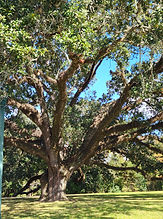
Trees embody beauty, truth, and value in quiet, enduring ways. Their beauty lies not in spectacle but in balance—root and branch, strength and flexibility, stillness and growth. Trees tell the truth of time: they reveal patience, resilience, and the reality that life unfolds slowly, season by season. They ask nothing yet give endlessly—shade, oxygen, shelter, and a sense of place. In their presence, human urgency feels smaller and more proportionate. Trees remind us that permanence is earned through care, that growth requires rootedness, and that the most valuable things often flourish beyond notice.

Drive-thru America
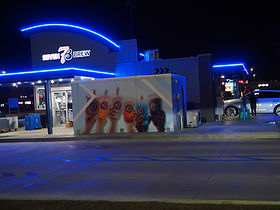
America's love affair with the drive-thru is less about laziness than logistics, culture, and time. Built around the automobile, the United States normalized speed, convenience, and personal space as everyday values. Drive-thrus fit a society that prizes efficiency and frictionless transactions--food without parking, coffee without conversation, prescriptions without waiting rooms. They reflect suburban sprawl, long commutes, and a work culture that often compresses meals into moving moments. Over time, the drive-thru became a ritual of modern American life: private, predictable, and optimized, reinforcing the belief that even basic human needs should adapt to the rhythms of the road.


Digital Art
Robert Slater does art and teaches at the University of Louisiana at Lafayette. His formal training was in social theory at the University of Chicago where he took his PhD, and at Harvard where he earned a master’s degree in philosophy and education. His digital art is a product of his reflections on self and society in the digital age and Jungian psychoanalytic theory. In the knowledge society, he writes, the self is increasingly a digital and digitized self. Art serves more and more as a means of self-formation and affirmation, and ever greater numbers of people engage in and practice it. In his digital art, the circles represent his (our) multiple selves which express themselves day-to-day in various ways (colors, sizes, and shapes). In the digital age, where reality is increasingly made of signs and symbols, our selves, always struggling for self-realization, are continually confronted, challenged and blocked by various obstacles, themselves often signs and symbols, which he represents with rectangular forms. At the same time, however, our selves are also continually faced with opportunities which we often achieve only partially and with compromise. But even in the moments when we are free, empowered and self-realized (represented by the full expression of the circular forms) we still find ourselves defined by (and against) the very things (forms, colors and backgrounds) we have managed to overcome


11_6_25.jpg)